
Buying a smartphone with genuinely useful AI features no longer means spending $1,000 or more. In 2026, mid-range devices are becoming smarter, faster, and more capable, bringing features such as AI photo editing, intelligent search, voice assistance, live translation, and automated writing tools to much more affordable price points.
But there is a catch: not every smartphone advertised as an AI phone offers the same experience. Some have dedicated AI processing hardware, while others depend heavily on internet-connected services. A powerful processor, sufficient RAM, efficient battery management, and long-term software support all matter when choosing a phone that will remain useful beyond its first few months.
For this TechSuggestion guide, we have selected five modern smartphones worth considering below the $600 price ceiling, using US and UK pricing as reference points. Prices and availability vary by country, retailer, storage configuration, and promotional offers, so check your local market before purchasing.
[IMAGE PLACEHOLDER 1]
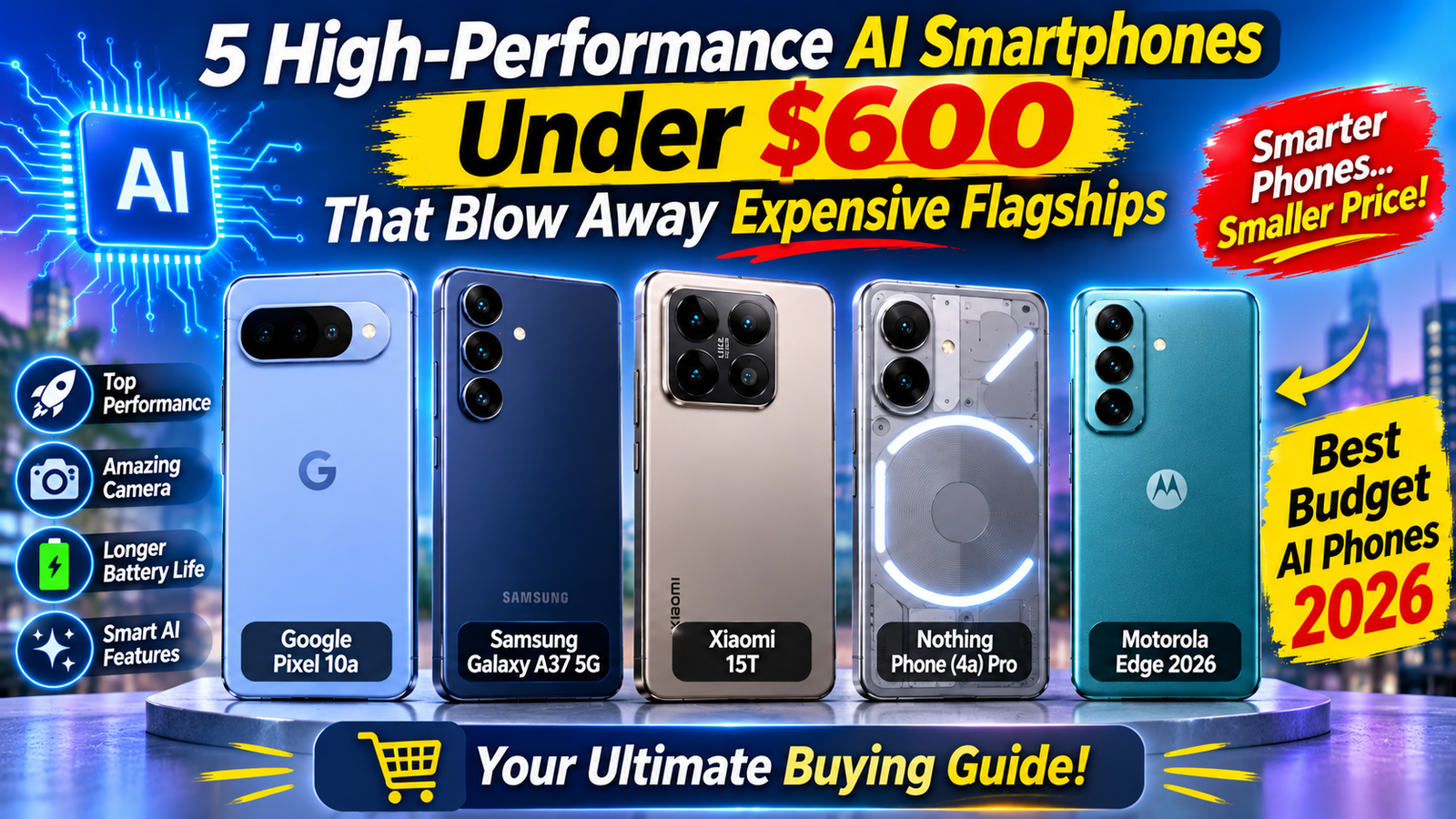
Suggested Image: A premium comparison image featuring the Google Pixel 10a, Samsung Galaxy A37 5G, Xiaomi 15T, Nothing Phone (4a) Pro, and Motorola Edge 2026, with subtle AI graphics and a clean technology-themed background.
SEO Alt Text: Best budget AI smartphones 2026 under $600 compared by performance, camera, battery, and AI features.
1. Google Pixel 10a – Best for Everyday AI and Photography
The Google Pixel 10a is a compelling choice for buyers who want useful AI features without paying flagship prices. Google’s strength has always been its combination of Android software, computational photography, and AI-powered services.
The Pixel 10a uses the Tensor G4 processor and includes 8GB of RAM, with 128GB and 256GB storage options. Its 6.3-inch OLED display supports a refresh rate of up to 120Hz, while the 5,100mAh battery is rated by Google for more than 30 hours of battery life under its stated testing conditions.
Its biggest advantage is the Pixel software experience. Google’s AI tools can help with photo editing, voice assistance, search, and everyday productivity. Features such as Gemini and Google’s photography tools make the phone particularly attractive to people who frequently capture pictures, edit images, or use voice commands.
The camera experience is another reason to consider it. Rather than relying only on megapixel numbers, Google uses image processing to improve exposure, detail, and colour.
My take: The Pixel 10a is the strongest starting point for users who value smart software and dependable point-and-shoot photography more than gaming performance.
Price reference: Around $499 at launch; check current US and UK retailer prices.
2. Samsung Galaxy A37 5G – Best for Balanced AI Features
Samsung’s Galaxy A37 5G brings its Awesome Intelligence features to a more accessible section of the smartphone market. It is designed for users who want a familiar Samsung experience, a capable camera system, and useful productivity tools.
The device runs on the Exynos 1480 platform and is available with different memory and storage configurations depending on the market. Its 6.7-inch Super AMOLED display and 5,000mAh battery make it a practical option for everyday use.
Samsung’s AI features include tools such as Voice Transcription, AI Select, and Object Eraser. These can help users turn recordings into text, extract information from what is displayed on screen, and remove unwanted distractions from photographs. Samsung also promises up to six generations of Android OS upgrades and up to six years of security updates for this generation.
The camera system combines a 50MP main camera with additional ultrawide and macro cameras. The main sensor is the one most users will rely on, particularly for everyday photographs.
My take: The Galaxy A37 is a sensible choice for Samsung fans who want a large display, familiar software, and useful AI editing features without moving into flagship pricing.
Price reference: UK pricing starts around £399 for the 128GB model, although retailer offers and storage variants can change the final cost.
3. Xiaomi 15T – Best for Performance, Display, and AI Productivity
If performance and a versatile camera setup are high on your priority list, the Xiaomi 15T deserves serious attention.
It is powered by the MediaTek Dimensity 8400-Ultra processor, supported by LPDDR5X RAM and UFS 4.1 storage. This combination gives it strong hardware credentials for multitasking, demanding applications, gaming, and AI-assisted features.
The 6.83-inch AMOLED display supports a 120Hz refresh rate, while its 5,500mAh battery and 67W wired charging make it attractive to people who spend long hours using their phones.
Xiaomi’s AI ecosystem includes AI Writing, AI Search, AI Interpreter, and AI Speech Recognition. These features can assist with writing, finding information, transcribing speech, and translating conversations. However, some functions rely on cloud-based processing and internet access, and availability varies by region and language.
Photography is another strength. The Leica-branded triple-camera system includes a 50MP main camera with optical image stabilisation, a 50MP telephoto camera, and a 12MP ultrawide camera. This gives users more flexibility than a basic dual-camera setup.
My take: The Xiaomi 15T is an excellent option for buyers who want a large, high-quality display, strong performance, fast charging, and AI-assisted productivity tools in one package.
Price reference: Check Xiaomi’s UK and European store listings for the current local price and promotions.
4. Nothing Phone (4a) Pro – Best for Creative AI Features
The Nothing Phone (4a) Pro takes a different approach. Instead of focusing only on traditional specifications, it combines distinctive design with software features intended to make everyday interactions more convenient.
It is powered by the Snapdragon 7 Gen 4 platform and features Nothing OS with Essential AI tools. Its AI experience includes Essential Space for capturing and organising information, Essential Search for finding content, and Essential Voice for turning speech into cleaner text.
Google Gemini is also integrated into the software, giving users an assistant for writing, planning, and learning. Nothing additionally includes ChatGPT integration through supported software features.
The camera system is particularly interesting. It includes a 50MP main camera with optical image stabilisation, a 50MP periscope telephoto camera, and an ultrawide camera. The telephoto lens makes it more flexible for distant subjects and portrait photography.
Its AI Eraser can remove unwanted objects and reflections from photographs, with Nothing stating that this particular feature runs on-device. That is a useful distinction for people who care about photo privacy.
My take: The Nothing Phone (4a) Pro is a strong choice for people who enjoy a distinctive design and want AI features integrated into their daily phone experience rather than hidden inside separate applications.
Price reference: Around $499 in the US and approximately £519 in the UK for the base configuration, subject to current offers.
5. Motorola Edge 2026 – Best for a Compact AI Smartphone
The Motorola Edge 2026 is worth considering if you prefer a relatively compact smartphone with modern AI features and a versatile camera system.
It uses the MediaTek Dimensity 7450 processor with 8GB RAM and 128GB storage in its listed US configuration. The 6.3-inch Extreme AMOLED display offers a 120Hz refresh rate, making it suitable for smooth everyday use.
Motorola’s moto ai includes Next Move, which recognises what’s displayed on the screen and suggests relevant next steps. For example, when planning a trip, it can suggest useful information based on what you are viewing. Google Gemini Live is also available for conversational assistance.
The camera setup includes three 50MP cameras, including a dedicated telephoto lens. This gives users more flexibility when photographing landscapes, portraits, and distant subjects.
A 5,000mAh battery supports 60W wired charging and 15W wireless charging. The phone also carries IP68 and IP69 ratings for dust and water protection.
My take: Motorola’s Edge 2026 is an interesting option for US buyers who want a smaller screen, useful contextual AI features, and a versatile camera system. Its availability outside North America should be checked before making a purchase.
Price reference: $599.99 unlocked in the US.
Quick Comparison: Which AI Smartphone Should You Buy?
| Smartphone | Best feature | Battery | Price reference |
|---|---|---|---|
| Google Pixel 10a | Google AI and photography | 5,100mAh | Around $499 |
| Samsung Galaxy A37 5G | Everyday AI tools | 5,000mAh | From £399 |
| Xiaomi 15T | Performance and AI productivity | 5,500mAh | Check local pricing |
| Nothing Phone (4a) Pro | Essential AI and camera flexibility | Check regional specs | Around $499 |
| Motorola Edge 2026 | moto ai and telephoto cameras | 5,000mAh | $599.99 |
Buyer’s Guide: What AI Hardware Should You Look for Under $600?
Before spending your money, look beyond the AI branding on the box. These are the specifications that can make a meaningful difference.
1. A Capable Processor and NPU
The processor handles everyday performance, while a neural processing unit (NPU) accelerates supported AI tasks. A modern chipset with dedicated AI capabilities can make features such as image processing and voice recognition more efficient.
2. At Least 8GB RAM
RAM matters when switching between applications, editing media, and using AI tools. For a phone you intend to keep for several years, 8GB is a sensible starting point. More RAM can help with heavier multitasking, although software optimisation matters too.
3. Understand On-Device AI Versus Cloud AI
This is one of the most important differences. On-device AI processes supported tasks directly on the phone, which can improve responsiveness and reduce the need to send data to external servers. Cloud AI uses remote computing resources and often requires an internet connection.
Do not assume every feature advertised as AI runs locally. Check the manufacturer’s documentation for each feature.
4. Battery Capacity and Software Support
A 5,000mAh battery is a useful starting point for many buyers, but real battery life also depends on display brightness, processor efficiency, signal strength, and usage habits. Long-term Android updates and security support are equally important because AI capabilities can evolve through software updates.
[IMAGE PLACEHOLDER 2]
Suggested Image: A clean infographic showing four essential AI smartphone components: processor and NPU, RAM, battery, and on-device AI processing, with a comparison between on-device and cloud AI.
SEO Alt Text: AI smartphone buying guide showing NPU processor RAM battery and on-device AI features.
Final Verdict: You Don’t Need a $1,000 Phone for Useful AI
The best budget AI smartphones in 2026 prove that buyers have more options than ever. The Pixel 10a is a strong choice for photography and Google’s AI ecosystem, Samsung’s Galaxy A37 offers a balanced everyday experience, and Xiaomi 15T stands out for performance and productivity.
Nothing Phone (4a) Pro is appealing for creative AI features and camera flexibility, while Motorola Edge 2026 offers a compact design with contextual AI assistance.
My Suggestion: If photography and smart software are your priorities, start with the Pixel 10a. If you want a more versatile camera and stronger hardware specifications, compare the Xiaomi 15T and Nothing Phone (4a) Pro. Before ordering, check local network compatibility, warranty coverage, storage configuration, and whether the AI features you want are supported in your country.
A premium price does not automatically mean a better experience. Choose the phone that solves your everyday needs, and you could keep hundreds of dollars in your pocket without missing the AI features that actually matter.
Editorial Profile Note: TechSuggestion is founded and owned by Abdul Rehman (CEO & Publisher). All editorial content, tech insights, and automated workflow guides are curated and authored under the publication title KhanWriter.
Want to Know more:https://techsuggestion.online/ai-workflow-automation-2026/
[…] Want to know about AI:https://techsuggestion.online/best-budget-ai-smartphones-2026/ […]