
KhanWriter
The premium smartphone market in 2026 is becoming increasingly competitive. Manufacturers are no longer competing only on processor speed or display quality. Camera technology, battery endurance, charging speeds, and professional video features are becoming just as important.
Two interesting contenders are the Xiaomi 18 Pro and the vivo X500 Pro Max. Xiaomi focuses on powerful Snapdragon hardware, high-resolution photography, and a large battery. vivo takes a more photography-focused approach, combining ZEISS optics, advanced telephoto technology, and impressive high-frame-rate video recording.
But which flagship deserves your money?
In this Xiaomi 18 Pro vs Vivo X500 Pro Max comparison, we examine their displays, performance, cameras, battery technology, and overall value for buyers in the US, UK, and Europe. One important distinction: the specifications below refer to the standard Xiaomi 18 Pro, not the more expensive Xiaomi 18 Pro Max.
Quick Summary: Xiaomi 18 Pro vs Vivo X500 Pro Max
The Xiaomi 18 Pro is designed for people who want powerful everyday performance, high-resolution photography, and a versatile Android experience. The vivo X500 Pro Max, meanwhile, is particularly attractive to mobile photographers and video creators who want advanced zoom capabilities and high-frame-rate recording.
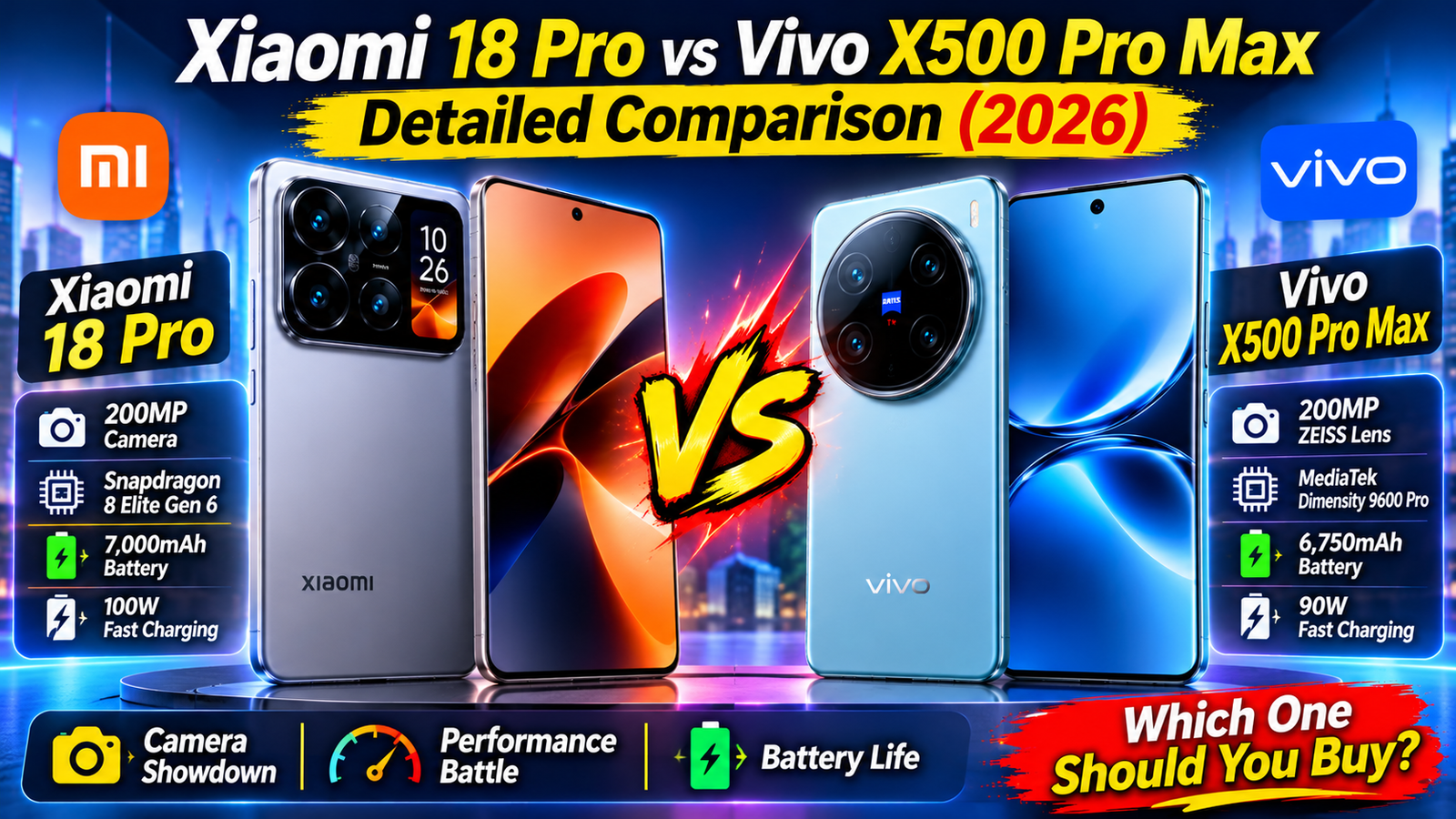
| Feature | Xiaomi 18 Pro | vivo X500 Pro Max |
|---|---|---|
| Processor | Snapdragon 8 Elite Gen 6 | Dimensity 9600 Pro |
| Main display | 6.4-inch AMOLED | 6.85-inch AMOLED |
| Refresh rate | 120Hz | Up to 144Hz |
| Main camera | 200MP | 50MP |
| Telephoto camera | 200MP, 3.2x | 200MP ZEISS APO |
| Video highlight | High-resolution video features | 4K 240fps |
| Battery | 7,000mAh (China) | 7,800mAh China / 6,750mAh Europe |
| Charging | 100W wired | 90W wired |
Specifications can differ between markets. Always check the exact regional model before purchasing.
Display and Build Quality: Compact Flagship vs Large Creator Screen
The display experience is one of the first differences buyers will notice.
Xiaomi 18 Pro
The Xiaomi 18 Pro features a 6.4-inch AMOLED display with a 120Hz refresh rate. Its relatively compact size makes it appealing to people who prefer a premium phone that is easier to handle with one hand.
Xiaomi also introduces a secondary display on the back of the device. This screen can show notifications and widgets and can act as a viewfinder when taking photographs with the rear cameras. It is more than a decorative addition because it gives users another way to interact with the phone.
The front display also supports a high-resolution viewing experience, making it suitable for streaming, gaming, and everyday browsing.
vivo X500 Pro Max
The vivo X500 Pro Max takes a larger-screen approach. Its 6.85-inch 2K AMOLED display supports an adaptive refresh rate of up to 144Hz. The additional screen space is particularly useful when editing photographs, watching videos, or managing multiple applications.
The ZEISS Master Color Display is designed to deliver accurate and natural-looking colours. Its large size also makes it a more comfortable choice for people who frequently consume media or create content on their smartphones.
Our verdict: Xiaomi is the more interesting choice for buyers who prefer a compact flagship with a secondary display. vivo has the advantage for users who want a larger, high-resolution screen for photography and entertainment.
Processor and Performance: Snapdragon vs Dimensity
A flagship smartphone should remain responsive during demanding tasks, not just everyday browsing. Both devices use advanced 2nm-class processor technology, but their platforms come from different manufacturers.
Xiaomi 18 Pro: Snapdragon 8 Elite Gen 6
The standard Xiaomi 18 Pro uses Qualcomm’s Snapdragon 8 Elite Gen 6. It is designed to deliver strong CPU and GPU performance for demanding applications, mobile gaming, image processing, and multitasking.
Qualcomm’s platform also supports modern AI processing capabilities. These can help with supported photography, voice, and productivity features.
It is important not to confuse this processor with the Snapdragon 8 Elite Extreme Gen 6, which is associated with the Xiaomi 18 Pro Max. The two Xiaomi models have different specifications.
vivo X500 Pro Max: Dimensity 9600 Pro
The vivo X500 Pro Max uses MediaTek’s Dimensity 9600 Pro, built on a 2nm process. It is paired with dedicated imaging hardware and vivo’s software processing system.
The combination is especially interesting for users who record high-resolution video and capture demanding photographic scenes. vivo’s imaging platform is designed to coordinate camera processing, stabilisation, and subject tracking.
Our verdict: Both phones offer flagship-level processing hardware. Xiaomi is an attractive option for buyers who prefer Qualcomm’s ecosystem, while vivo’s processor and imaging platform make more sense for people prioritising advanced camera and video workflows. Real-world performance and thermal testing will ultimately determine which phone performs better during extended gaming sessions.
Camera Breakdown: 200MP Telephoto vs 4K Slow-Motion Video
This is where the competition becomes particularly interesting.
Xiaomi 18 Pro: High-Resolution Photography
Xiaomi equips the 18 Pro with a 200MP main camera, a 200MP 3.2x telephoto camera, and a 50MP ultrawide camera.
The high-resolution telephoto sensor is a major selling point. It gives photographers more flexibility when capturing distant subjects, portraits, and detailed images. The secondary rear display also makes it easier to frame photographs using the main camera system.
However, megapixels alone do not determine camera quality. Sensor size, optical stabilisation, lens quality, image processing, and lighting conditions all influence the final photograph.
vivo X500 Pro Max: ZEISS Telephoto and Cinematic Video
The vivo X500 Pro Max takes a different approach, with a 200MP ZEISS APO telephoto camera and advanced optical zoom accessories. Its telephoto system is particularly appealing for concert photography, wildlife, sports, and distant subjects.
Its biggest video advantage is native 4K recording at 240 frames per second. This allows creators to capture fast-moving scenes and produce smooth slow-motion footage while retaining substantial image detail.
The phone also offers advanced subject tracking and professional video features, making it an appealing tool for mobile content creators.
Our verdict: Xiaomi is an exciting choice for high-resolution still photography, while vivo has a particularly strong case for telephoto photography and high-frame-rate video. If recording slow-motion footage is important to you, the X500 Pro Max deserves serious consideration.
Battery Life and Fast Charging: Which Phone Lasts Longer?
Battery capacity is another major selling point for both devices.
The Xiaomi 18 Pro has a 7,000mAh battery in its Chinese specification, supported by 100W wired charging and 27W wireless charging. That is a substantial capacity for a compact flagship. However, buyers should check the final global specification because international models may use a different battery configuration.
The vivo X500 Pro Max offers a larger battery in its Chinese configuration, listed at 7,800mAh. Its European specification lists a 6,750mAh equivalent battery, with 90W wired FlashCharge and 40W wireless charging.
This regional difference matters. A European buyer should not assume that the Chinese battery specification applies to the European model.
Both phones offer enough battery capacity to look promising for demanding users, but actual endurance depends on display brightness, gaming, camera use, mobile signal, and software optimisation.
Our verdict: vivo has the larger listed battery in China, while Xiaomi offers faster wired charging on paper. European buyers should compare the actual regional battery capacities before making a decision.
Price and Availability: What Should US, UK, and European Buyers Know?
The Xiaomi 18 Pro debuted in China, and Xiaomi has announced plans for international availability in November 2026. However, the exact launch markets and final regional specifications need to be checked before ordering. The US market should not be assumed to receive the same availability as Europe.
The vivo X500 Pro Max also launched first in China, with international listings appearing in selected markets. Its European specification confirms that regional battery and software configurations can differ.
Neither phone should be judged using converted Chinese prices alone. European VAT, import costs, retailer margins, warranty arrangements, and local availability can significantly change the final price.
For US buyers, it is particularly important to verify whether the exact model supports local carrier bands and comes with an appropriate warranty. For UK and European buyers, check software region, Google service availability, and the seller’s return policy.
Final Verdict: Which Flagship Should You Buy?
The Xiaomi 18 Pro and vivo X500 Pro Max are aimed at slightly different types of flagship buyers.
The Xiaomi 18 Pro is a compelling option for people who want a compact premium phone, a powerful Snapdragon processor, dual 200MP camera hardware, and a useful secondary display. Its 100W wired charging is another advantage.
The vivo X500 Pro Max is more appealing to mobile photographers and video creators. Its 200MP ZEISS telephoto system, 4K 240fps recording, large display, and high-capacity battery make it an impressive camera-focused flagship.
My Suggestion: Choose the Xiaomi 18 Pro if you prefer a compact flagship with versatile photography hardware and Qualcomm performance. Choose the vivo X500 Pro Max if telephoto photography, cinematic slow-motion video, and a large display are your priorities.
Neither phone is automatically the better purchase for everyone. Before spending flagship money, compare the exact regional specifications, warranty coverage, and final retail price. A great camera matters, but so does buying the right version of the phone.
Editorial Profile Note: TechSuggestion is founded and owned by Abdul Rehman (CEO & Publisher). All editorial content, tech insights, and automated workflow guides are curated and authored under the publication title KhanWriter.
Want to know about AI:https://techsuggestion.online/best-budget-ai-smartphones-2026/