
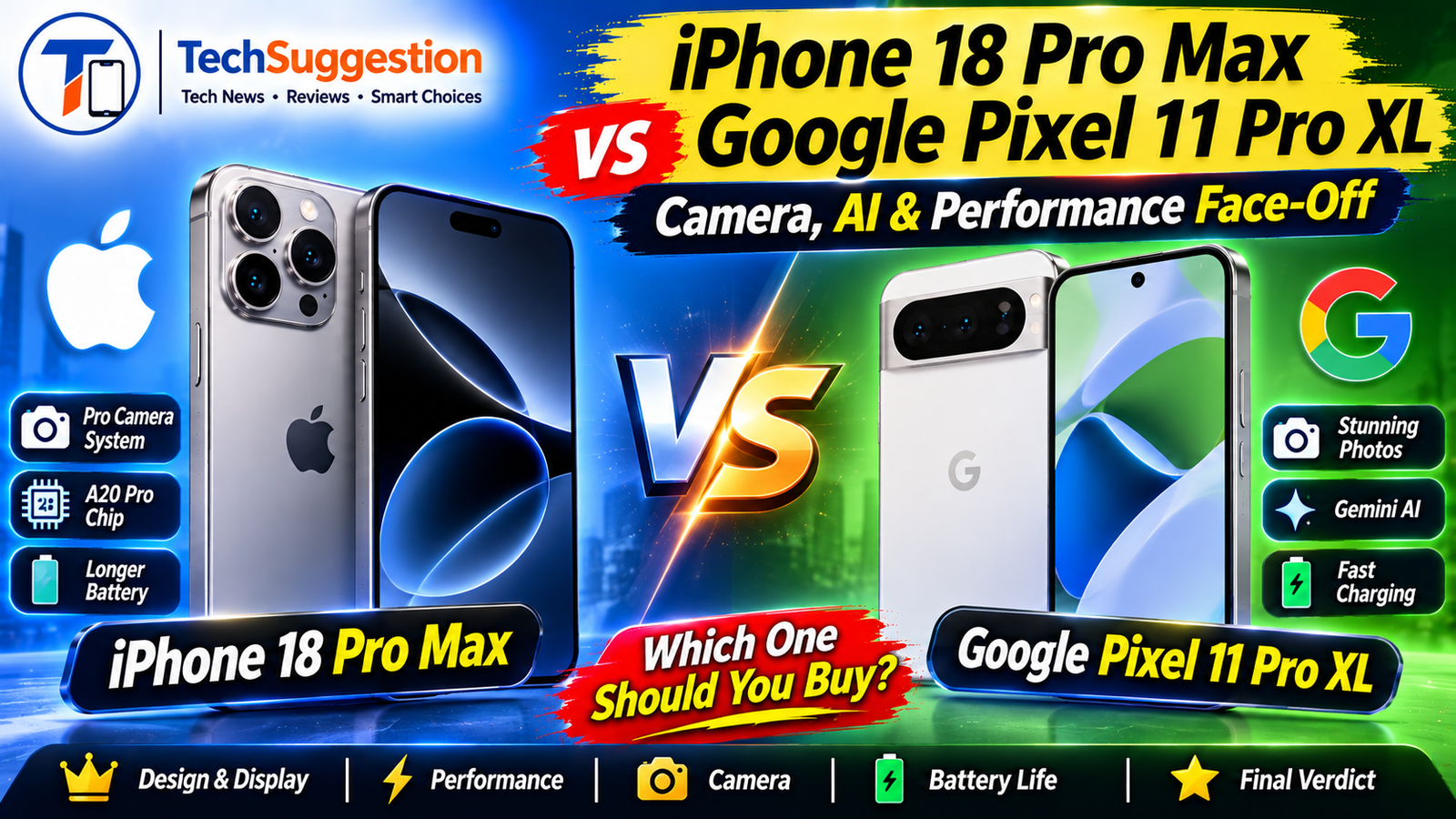
Introduction: Apple vs Google Flagship Rivalry in 2026
Choosing between Apple’s most advanced iPhone and Google’s latest Pixel flagship is not an easy decision. The iPhone 18 Pro Max vs Google Pixel 11 Pro XL comparison brings together two different approaches to premium smartphones. Apple focuses on powerful hardware, professional video tools and a tightly connected ecosystem, while Google puts computational photography, Gemini AI and intelligent software experiences at the centre of its flagship.
Both phones offer large, high-quality displays, advanced camera systems and long-term software support. However, their strengths are different. The iPhone is particularly attractive to creators and people already using Apple products, while the Pixel is appealing to Android users who want Google’s latest AI and photography features.
Let’s compare them in the areas that matter most before spending flagship-level money.
Design, Build Quality & Display Experience
The iPhone 18 Pro Max features Apple’s aluminium unibody design, Ceramic Shield 2 protection and a premium glass finish. Its 6.9-inch Super Retina XDR OLED display supports ProMotion with adaptive refresh rates up to 120Hz. The large screen is excellent for watching videos, editing photographs, gaming and multitasking.
Google takes a slightly different approach with the Pixel 11 Pro XL. It features a 6.8-inch Super Actua LTPO OLED display with a 1–120Hz refresh rate. One of its biggest advantages is brightness: Google advertises peak brightness of up to 3,600 nits, which should make outdoor viewing more comfortable in bright conditions.
The Pixel also features Gorilla Glass Victus 2 with an anti-scratch display coating, while its camera bar gives it a recognisable appearance.
Which display is better?
Both are excellent for everyday use. Apple’s larger display offers a little more screen space, while Google’s advertised peak brightness is higher. If outdoor visibility is particularly important, the Pixel deserves serious consideration. For users who prefer Apple’s display tuning and familiar iOS experience, the iPhone remains a strong choice.
Processor Power vs Google AI & Gemini Integration
Performance is one of the biggest differences between these two smartphones.
iPhone 18 Pro Max: A20 Pro Performance
Apple’s A20 Pro chip is built using a 2-nanometre process and includes a six-core CPU, seven-core GPU and an upgraded Neural Engine. Apple also introduces improved thermal management with a redesigned vapour chamber to help maintain performance during demanding tasks.
This makes the iPhone a compelling option for mobile gaming, professional video editing, photography and intensive applications. Its powerful hardware is also designed to support Apple’s latest on-device intelligence features.
Pixel 11 Pro XL: Tensor G6 and Gemini
Google’s Tensor G6 chip is designed around AI-powered experiences. It works with Google’s latest Gemini Nano model and supports Gemini Intelligence features that can provide more contextual assistance throughout the phone.
For everyday users, this can mean smarter voice interactions, useful writing assistance and more intelligent software tools. Google also includes a Titan M3 security coprocessor and advertises seven years of operating system, security and Pixel Drop updates.
My take: Apple’s A20 Pro looks particularly attractive for sustained performance and demanding creative workloads. Google’s Tensor G6 makes the Pixel more interesting for people who want AI deeply integrated into their everyday smartphone experience. Raw specifications alone do not determine which phone feels faster in real-world use.
Camera Showdown: Real-World Photography, Zoom & Video Stabilization
Camera quality could be the deciding factor for many buyers.
The iPhone 18 Pro Max features a 48MP Pro Fusion camera system with a variable-aperture main sensor, a 48MP ultra-wide camera and a 48MP telephoto camera. Its telephoto system provides 4x optical zoom and up to 8x optical-quality zoom. This gives photographers flexibility when capturing portraits, landscapes and distant subjects.
Apple also offers advanced video capabilities, including 4K Dolby Vision recording, ProRes options and optical image stabilization. For creators who regularly record professional-looking footage, these tools are a major advantage.
Google’s Pixel 11 Pro XL features a triple rear camera system with a 50MP main sensor, 48MP ultra-wide camera and 48MP 5x telephoto lens. Its Pro Zoom feature reaches up to 120x, while the upgraded telephoto sensor is designed to improve light sensitivity. Google has also introduced faster Night Sight processing and Portrait Mode at 5x.
The difference is in their priorities. Apple’s camera system provides extensive manual controls and professional video formats. Google’s computational photography and AI-assisted processing are designed to make impressive photographs easier to capture.
My suggestion: Choose the iPhone if video recording and editing flexibility are your priorities. Consider the Pixel if you enjoy experimenting with zoom, portraits, night photography and Google’s computational camera features. Actual image quality still depends on lighting, movement and shooting conditions.
Battery Endurance, Charging Speeds & Ecosystem Value
Battery life matters when buying an expensive smartphone. Apple advertises up to 45 hours of video playback for the iPhone 18 Pro Max, while Google claims more than 30 hours of battery life for the Pixel 11 Pro XL.
These figures come from different testing methods, so they should not be treated as a direct real-world comparison. Your screen brightness, camera use, gaming and mobile network conditions will affect actual endurance.
Charging is another area where Google has a clear specification advantage. The Pixel 11 Pro XL supports wired charging up to 75% in around 30 minutes with a suitable 45W USB-C PPS charger. It also supports Qi2.2 wireless charging up to 25W.
Apple’s charging performance depends on the compatible adapter and charging method, so buyers should check the official requirements rather than assume every USB-C charger delivers maximum speeds.
The ecosystem may matter even more than charging. The iPhone works particularly well with Mac, Apple Watch, AirPods and iCloud. Pixel users benefit from Google’s services, Android flexibility and Gemini integration.
Final Verdict: Which Flagship Should You Buy?
The iPhone 18 Pro Max and Google Pixel 11 Pro XL are both impressive premium smartphones, but they serve slightly different audiences.
Choose the iPhone 18 Pro Max if you want powerful performance, advanced video recording, professional camera controls and seamless integration with Apple’s ecosystem.
Choose the Google Pixel 11 Pro XL if you prefer Android, Google’s Gemini AI experience, computational photography, high zoom flexibility and faster advertised charging.
My final recommendation is to think about how you actually use your phone. If you create videos, play demanding games or already own several Apple devices, the iPhone is a sensible investment. If photography, AI assistance and Google’s software experience matter more, the Pixel could be the better everyday companion.
There is no universal winner here. The smarter purchase is the flagship whose strengths match your daily needs—not simply the one with the bigger marketing numbers.
Editorial Profile Note: TechSuggestion is founded and owned by Abdul Rehman (CEO & Publisher). All editorial content, tech insights, and automated workflow guides are curated and authored under the publication title KhanWriter.
Check https://techsuggestion.online/ for new blogs and tech news.
Check Out Our Latest Blog: https://techsuggestion.online/best-iphones-for-every-budget-2026/